

Stop Paying the “Lazy Tax” : How to Save Thousands on Household Bills
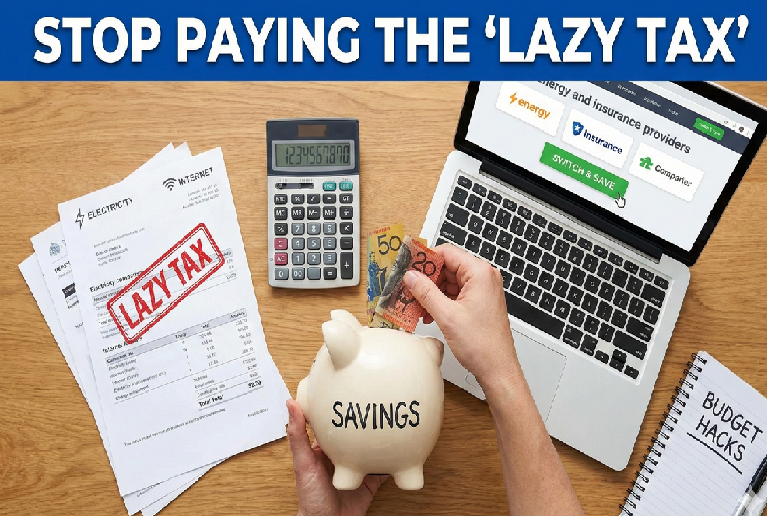
If you have been loyal to your bank, insurer, or energy provider for more than two years, there is a high chance you are being ripped off. In the finance world, we call this the lazy tax Australia relies on to boost corporate profits.
It sounds harsh, but it’s the reality of the Australian service industry. Companies offer incredible “honeymoon deals” to lure in new customers, while existing loyal customers get hit with price hikes every renewal period. The cost of living in Australia is high enough without voluntarily paying more than you need to.
The good news? You can claw that money back. With a few phone calls and some smart comparison work, the average Australian household can save anywhere from $500 to $2,000 a year. Here is your practical guide to beating the lazy tax and keeping more cash in your pocket.
1. The Golden Rule of Energy: Never Set and Forget
Electricity and gas prices in Australia fluctuate wildly. If you haven’t looked at your energy bill in the last 12 months, you are almost certainly on a “default market offer” or an expired benefit period, which is rarely the cheapest option.
You don’t need a broker to fix this. The Australian Government runs a free, independent comparison site called Energy Made Easy.
- Grab your latest bill.
- Plug in your usage data or upload the PDF.
- The site will show you exactly how much you could save by switching retailers.
Real-world win: Switching from a legacy plan to a current market offer can often save a standard 4-person household between $300 and $500 annually.
2. Car and Home Insurance: The Annual Phone Call
Insurance premiums are skyrocketing across the country due to weather events and inflation. However, renewal notices often include a “loyalty tax” where the premium jumps significantly simply because the insurer assumes you won’t bother to check elsewhere.
Before you pay your renewal:
- Go to a comparison site and get three quotes from competitors for the same level of cover.
- Call your current insurer.
- Say this exact script: “I’ve been a loyal customer, but I’ve found a policy with [Competitor] for $150 less. I’d prefer to stay with you, but I can’t justify the price difference. What can you do to match it?”
Customer retention teams have the power to apply discounts that aren’t advertised online. If they won’t budge, be prepared to walk.
3. Mortgage Rates: The Silent Budget Killer
For homeowners, the mortgage is the biggest monthly expense. A difference of just 0.5% on a $500,000 loan doesn’t sound like much, but it adds up to roughly $2,500 a year in interest.
Banks often charge existing customers a higher variable rate than they offer to new sign-ups. Check your bank’s website to see what interest rate they are advertising for new customers. If your rate is higher, call them.
Ask for a “rate review.” Tell them you are looking to save money on bills and have seen better rates elsewhere. Often, the bank will lower your rate on the spot to avoid the paperwork of you refinancing to another lender.
4. Internet and NBN: Speed Up, Pay Less
The NBN market is incredibly competitive. Providers are constantly battling for market share with introductory offers that last for six months. Once that period ends, the price usually reverts to a standard, higher rate.
Check your internet speed and price. If you are paying more than $75–$85 a month for a standard NBN 50 plan, you are paying too much.
- Tip: Look for “churn” deals. Many providers offer “first 6 months for $65” deals.
- The Hack: Set a calendar reminder for the month the discount ends. When the alarm goes off, switch providers again. It takes about 15 minutes of effort to save $120+ a year.
5. Mobile Plans: Ditch the Handset Contract
Are you still paying off a phone that you bought three years ago? Or are you on a massive data plan you never fully use?
The most cost-effective way to manage mobile expenses in Australia is to buy a phone outright (or second-hand) and use a SIM-only plan. Big telcos charge a premium, but smaller providers (MVNOs) that use the exact same networks (Telstra, Optus, or Vodafone) offer massive data limits for a fraction of the price.
You can easily find SIM-only plans with unlimited talk and text and 25GB of data for under $25 a month. Compare that to your current $60+ contract.
6. Streaming Services: The “Subscription Rot”
We all love our entertainment, but paying for Netflix, Stan, Disney+, Amazon Prime, and Kayo all at once is a quick way to drain $100 a month.
To combat the cost of living Australia is facing, adopt the “Rotate Strategy.” Only pay for one service at a time. Binge the shows you want to watch on that platform for a month or two, then cancel it and switch to the next one.
Most services have no lock-in contracts, making this an easy way to save $600 a year without missing out on your favourite shows.
Final Thoughts: Your Money, Your Rules
Beating the lazy tax isn’t about being stingy; it’s about being smart. Corporations count on your apathy to make their profit margins. By taking one afternoon to audit your bills and make a few phone calls, you are effectively paying yourself a massive hourly wage.
Don’t let your loyalty cost you. Check your bills, make the call, and keep that hard-earned Aussie dollar in your own pocket.